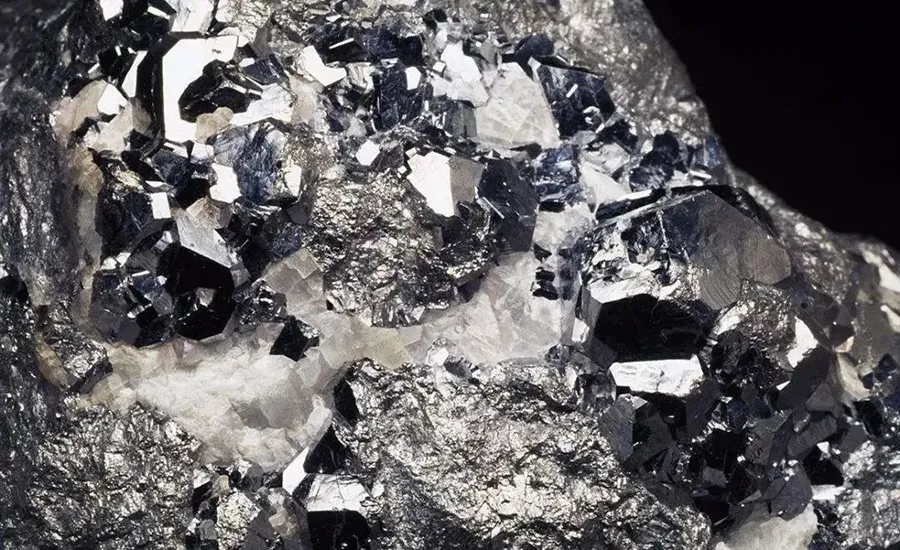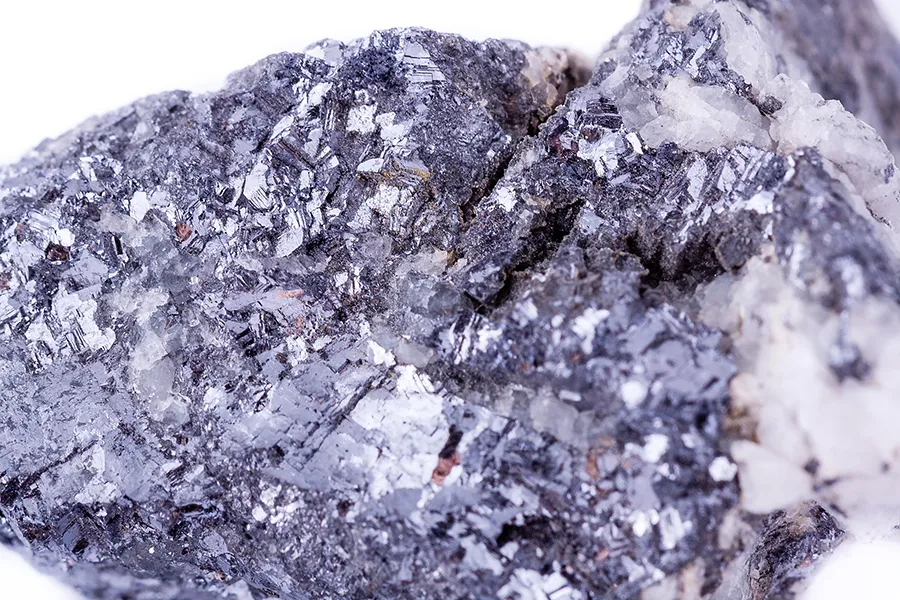
REO Minerals
7.6.1 Ore and Minerals Containing Rare Earth Oxide Elements(REOE) There are about 250…

7.2.3 Beneficiation Process for Complex Sulfide Ores
Complex sulfide ores discussed here involve copper sulfur ore,copper sulfur iron ore,copper molybdenum ore,and copper nickel ore.
7.2.3.1 Flotation Separation of Copper Sulfide Ore
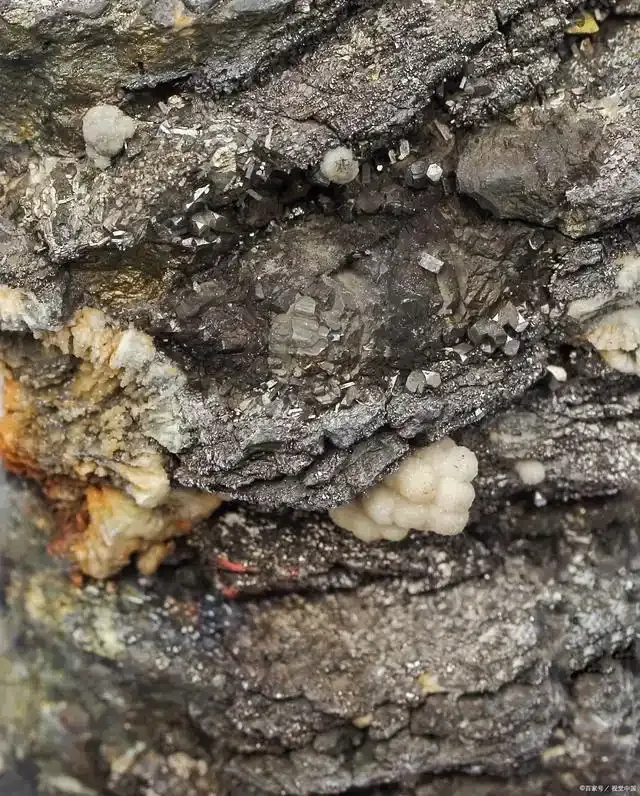
Copper sulfide deposit is one of the main types of copper deposits in China.Most of these deposits are copper pyrite and copper skarn deposits,which are widely distributed.They can be dense massive or disseminated.There is more pyrite in dense massive ore than in disseminated ore.The characteristics of dense massive copper bearing pyrite are that pyrite is the main mineral with a content as high as 50%-95%,with little gangue minerals.For this kind of ore,the tailings are pyrite concentrate after the copper sulfide mineral is floated.If gangue content is high,tailings should also be produced.As to the disseminated copper pyrite,there are relatively small amount of copper and iron sulfides which are disseminated in gangue.
A Selective Flotation Process
Copper flotation goes first,followed by sulfur flotation.In the case of dense massive ore,high alkaline pulp with over 600-800g/m³free Ca0 and high xanthate dosage are generally used to float copper with sulfur depressed,producing sulfur concentrate as a flotation tailing.In the case of disseminated ore,sulfur flotation of the tailings from copper flotation is necessary and low alkaline pulp is used as far as possible in copper flotation in order to reduce the sulfate acid consumption and ensure safer operation in sulfur flotation.
B Bulk Flotation Process
For the copper sulfur ore with low sulfur content and easy-to-float copper minerals,bulk flotation is carried out in weak alkaline pulp,and then copper and sulfur in the bulk concentrate are separated in the high alkalinity pulp by adding lime.
C Selective and Bulk Flotation Process
Collectors of good selectivity such as Z-200 or OSN-43 and ester-105 are used for selective flotation of copper minerals with good floatability,where part of the copper concentrate is obtained. Then bulk flotation is carried out with its bulk concentrate of copper and sulfur being separated then by floating copper and depressing sulfur.This process can avoid the possible depression of copper minerals by large quantity of lime and does not need a lot of sulfuric acid to activate pyrite.
The reagent regime for copper sulfur ore can be concluded as:
(1)High selective collectors such as lipid with good selectivity but weak strength to collect pyrite should be used.
(2)Lime is commonly used to give strong alkaline environment and depress pyrite.The pH or the content of free CaO in pulp can affect the separation significantly.The general rule is that a large amount of lime should be added when dealing with dense massive ore containing more pyrite, so that the free CaO in the pulp can reach about 800g/m³to depress pyrite.For the disseminated ore with less pyrite,controlling the pH of pulp with lime at 9-12 can float copper and depress sulfur.The disadvantage of this method is that the sticky foam is easy to cause spilling over the concentrate launder and may cause calcium accumulation in the equipment and pipelines.
(3)Lime together with sulphurous acid is a widely used pyrite depressing method without using of toxic cyanids and is suitable for copper sulfide ore with high sulfur or slime content,or with active pyrite which is not easy to be depressed by lime.The key is to control the appropriate pulp pH at 6.5-7 and the amount of sulphurous acid,and strengthen aeration and agitation.Compared with the lime only method,it has the advantages of stable operation,good copper index and low consumption of activators such as sulfuric acid.
(4)Lime together with organic depressant is also a method to give good depressing of pyrite.
(5)Lime together with cyanide is suitable for pyrite with high floatability.The depressed pyrite can be floated after reducing pH by adding sulfuric acid.
(6)Heating can also be used to accelerate the surface oxidation of pyrite and depress pyrite.
7.2.3.2 Separation of Copper Sulfur Iron Ore
Copper sulfur iron ore is mainly skarn type copper deposits,which are normally small in reserves and of low grade,containing mainly chalcopyrite,and some magnetite,pyrite and pyrrhotite.
Selective flotation or bulk flotation followed by separation is often adopted for copper and sulfur, while low intensity magnetic separation is used for the recovery of magnetite.Flotation can go ahead of magnetic separation or vice versa.If magnetic separation is carried out first,the sulfur content in iron concentrate is readily higher than required because pyrrhotite can influence the quanlity of the iron concentrate.It is critical to improve the flotation recovery of pyrrhotite both for increasing sulfur recovery and for decreasing sulfur content in iron concentrate.
One example of copper sulfur iron ore is Daye Iron Mine.It is a large iron mine containing copper,sulfur and cobalt,treating 10000t ROM ore per day.The ore is crushed in a three-stage open circuit and ground in a two-stage closed-circuit.Bulk flotation with two roughers and two cleaners is carried out to obtain copper sulfur bulk concentrate,where cobalt,gold and other associated components also report to the bulk concentrate.Copper flotation is then carried out by depressing sulfur in high alkaline pulp at pH>12 with the help of lime,where both copper and sulfur concentrate are obtained.Gold,silver and other valuable components report to the copper concentrate while cobalt reports to sulfur concentrate and can be sold as sulfur cobalt concentrate. The tailings of bulk flotation are treated by low-intensity magnetic separation to recovery iron and produce iron concentrate.
7.2.3.3 Flotation Separation of Copper Molybdenum Ore
Copper molybdenum deposit finds its greatest industrial utilization in porphyry copper sulfide deposits.Porphyry copper sulfide deposit is of large reserve and is an important resource for extracting copper.It is characterized by low grade:Cu 0.5%-1%,Mo 0.01%-0.03%
In this kind of ore,copper mainly occurs as chalcocite(Cu₂S)and chalcopyrite(CuFeS₂), and molybdenum occurs mainly as molybdenite(MoS₂).There are three kinds of beneficiation process for copper molybdenum ore.
(1)Bulk flotation followed by regrinding and copper molybdenum separation of the primary bulk concentrate is the most widely used process,especially for porphyry copper ore,where the sulfide minerals occur as coarse grains and present good floatabilitiy.They can be collected by common cllectors such as xanthate and frothers.
In the one-stage primary grinding,over 90%of the tailings can be discarded by bulk flotation, reducing grinding cost.The primary bulk concentrate is reground and copper molybdenum bulk concentrate can be obtained by depressing sulfur with lime.The copper molybdenum bulk concentrate is further separated by flotation to get molybdenum concentrate and copper concentrate.The primary sulfur concentrate can be cleaned by flotation or gravity concentration to get final sulfur concentrate.
(2)Bulk flotation of copper and molybdenum and sulfur depression separation is used for copper molybdenum ore which is of fine-grained,low pyrite content and general floatability.
(3)Pulsating high gradient magnetic separation of copper molybdenum bulk concentrate utilizes the weak magnetism of chalcopyrite while molybdenite is non-magnetic.The disadvantage is that the particle size of copper and molybdenum minerals is very fine,and the copper minerals are of quite weak magnetic,leading to relatively poor recovery and low enrichment ratio.
The reagent regime for copper depressing and molybdenum flotation involves:Na₂S including both NaHS and ammonium sulfide,Na₂S accompanied by steam heating,single cyanide,cyanide accompanied by Na₂S,Knox reagent,oxidizer such as NaCl0 or H₂O₂,and organic depressants such as mercapto acetic acid.Na₂S,cyanide or Knox agents are much effective in depressing chalcopyrite and bornite,while ammonium sulfide,ferricyanide and ferrocyanide,oxidant sodium hypochlorite and hydrogen peroxide are effective in depressing secondary copper sulfide. Mercaptoacetic acid and other organic depressants are new developed molybdenum sulfide depressants with no toxic and high-efficiency,and are still in promotion.
To strengthen the separation of copper and molybdenum,the following methods can be used:
(1)Densification and agent removal is essential before the separation of the bulk concentrate to remove excess agents in the bulk concentrate and ensure hat the agitation and separation are carried out under the appropriate concentration.
(2)Steam heating of the bulk concentrate to 85-90℃ is used in some countries to desorb and destroy the collector film on the surface of the bulk concentrate,sometimes with the addition of some lime,and introducing of oxygen or air.This method has good effect but high cost and results in complex process.
(3)Deactivating process which put the slurry in storage banks for a long time with air introduced,is used to make the surface of chalcopyrite oxydize and hydrophilic.It can also make the xanthate ineffective because xanthate on the chalcopyrite surface and in the pulp can be oxidized and decomposed at low pH and when heated or aerated for a long time.This method can
thus decrease the floatability of chalcopyrite.
(4)Stage addition of sodium sulfide helps to utilize the heat released when sodium sulfide is dissolved.Part of sodium sulphide solution is added to the stirring tank,while the other part is added in solid to the rougher and cleaner cells,making use of the dissolving heat to increase the pulp temperature and improve the depressing of chalcopyrite.
(5)Flotation with nitrogen can prevent reagent oxidation,reducing the dosage,and is used in the United States,Canada and other countries.In the separation of copper and molybdenum, there are as many as 6 to 8 cleaning operations,which results in a long operation line,making the depressants easy to become ineffective.Introducing of nitrogen helps to prevent the oxidation and save Knox consumption by 50%-70%.
(6)Flotation columns can be used for cleaning,which present thick froth layer and are efficient for cleaning,reducing the number of cleaning operations.
7.2.3.4 Flotation Separation of Copper Nickel Ore
Nickel occurs as pentlandite(Fe,Ni)₉Sg,millerite NiS,nickelite NiAs,and nickel-bearing pyrrhotite in copper nickel ores.The floatability of pentlandite and millerite is between chalcopyrite and pyrrhotite,and they can be collected with high-grade xanthates such as butyl or amyl xanthate in weak acid or weak alkali pulp.Cupric sulfate is the activator of pentlandite and lime is its depressant.The separation of copper and nickel is mainly by flotation,while magnetic separation and gravity concentration are usually used as supplyment.
There are two flotation separation processes for copper nickel ore:
(1)The bulk concentrate of copper and nickel is obtained by flotation,and then smelted to get nickel matte,which is then casted and crystallized under temperature-reserving conditions to produce artificial rich ore.The rich ore is then crushed and ground to carry out flotation in high NaOH medium.This method gives relatively high recovery but claims high cost as well.It is used in many countries to get copper concentrate and nickel concentrate followed by separate smelting.
(2)Selective flotation is carried out to obtain copper concentrate and nickel concentrate respectively.This is the case if there is much more copper than nickel in the ore and copper concentrate with low nickel content can be obtained.It is desirable that copper can report into nickel concentrate but nickel should be prevented from reporting into copper concentrate.This is because nickel will be lost greatly during copper smelting while the nickel in the copper concentrate can be recovered completely during smelting.
The copper nickel flotation process has the characteristics of simple process,long flotation time, less clearners,and early recovery of copper nickel minerals.The nickel grade in copper nickel concentrate is generally 4%-8%.The removal of pyrrhotite is the key to improve the quality of copper nickel concentrate,so combined process of flotation with magnetic separation is often used. The removal of magnetic gangue such as talc and chlorite is critical to improve the quality of nickel concentrate.