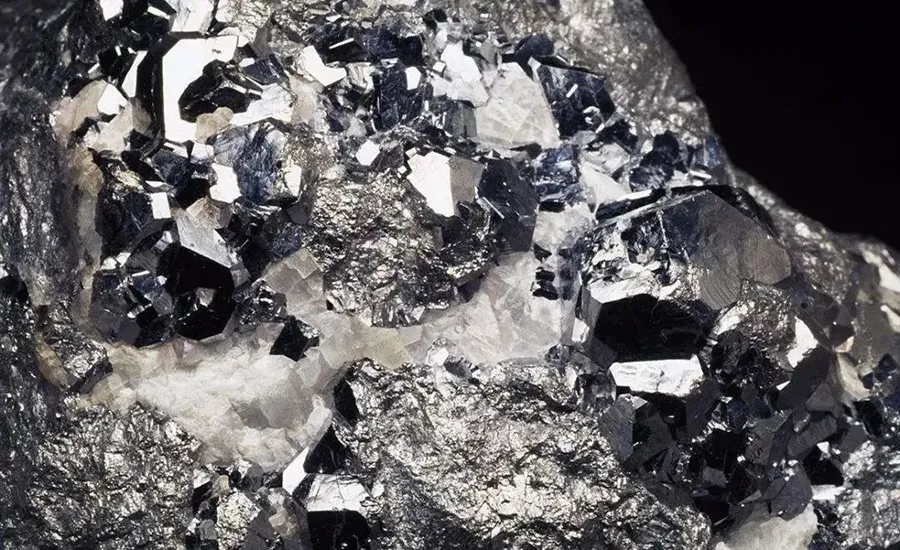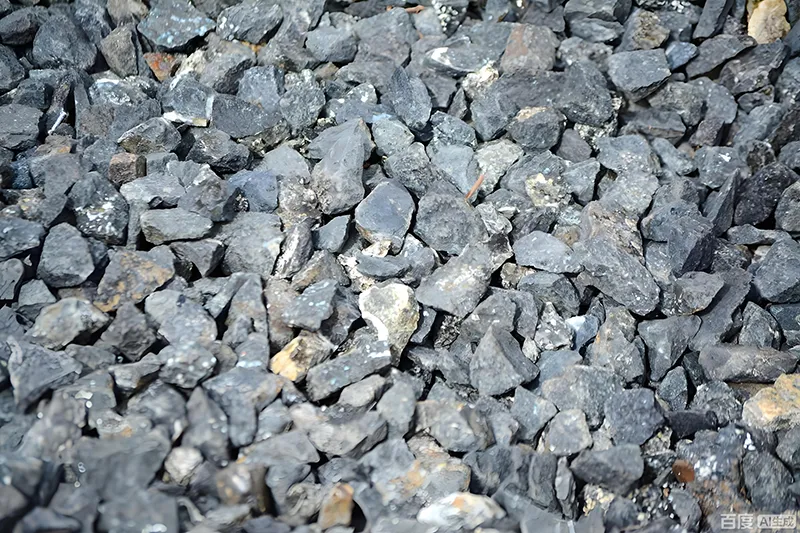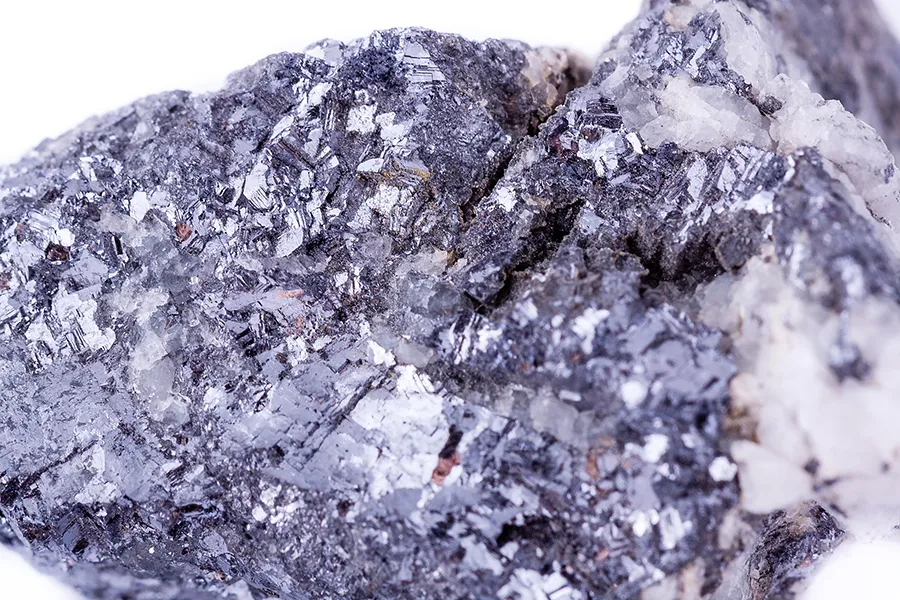
REO Minerals
7.6.1 Ore and Minerals Containing Rare Earth Oxide Elements(REOE) There are about 250…
Beneficiation Process for Magnetite
6.3.1 Low-Intensity Magnetic Separation Process
Low-intensity magnetic separation process is applicable for magnetite or vanadium-titanium magnetite,with the magnetite being the main recovery object.This process is characterized by comminution to a proper size,a three-stage roughing separation,and a one-stage cleaning.Wet low intensity magnetic separators involving counter-current or counter-rotation types are commonly used for roughing,and magnetic separation columns are used as cleaners.Dewatering tanks are always used before magnetic separators to reject nonmagnetic slimes.In the case of the ores with coarse particle size or high iron content,continuous grinding &low intensity magnetic separation process is recommended,for example,if the run-of-mine ore is crushed and ground to a size larger than 0.2-0.3mm.In the case of the ores with fine dissemination or low head grade,stage-grinding separation process is necessary,that is,rougher is used to reject parts of the tailings after the primary grinding and reduce the workload of subsequent grinding and separation.Fine screening is often used to return the oversized to regrinding.
Fig.6.1(a)shows a stage-grinding separation process once applied to the magnetite production in Anshan Benxi and Jidong areas.Demagnetization is to prevent magnetic agglomeration from affecting classification effect and avoid over grinding.Pre-magnetization is to reduce fine ore loss.Mechanical classifier is always used for >0.1mm and hydrocyclone for <0.1mm.The content of -200M accounting for 95%is equivalent to 0.074mm.Fig.6.1(b)is an improved lowsheet of Fig.6.1(a)including three-stage of grinding and four-stage fine screening,which increased the concentrate grade from 62%-63%to over 65%.
(a) (b)
Fig.6.1 Stage-grinding separation process
(a)stage-grinding separation process in Anshan;(b)improved stage-grinding separation process in AnshanThe fine screens operated at high frequency serve to prevent the oversized locked particles from going into the cleaning operation and influencing the grade of the final product.These oversized particles are reported into the overflow of the hydrocyclone because of equal settling.They contain only small amounts of magnetite,but are always recovered into the concentrate.The fine screen
helps to discard these particles or return them to regrinding operations,and thus improve the grade of the undersized materials.The screening efficiency influences the performance of the fine screens.The high-frequency fine screens in use involve MVS series developed by Tangshan Lukai Technology Co.,Ltd.,GPS type developed by Changsha Research Institute,gyx31-1007 developed by Guangzhou Nonferrous and Derrick high-frequency vibrating screen from US.
6. 3.2 Combination Process of Low-Intensity Magnetic Separation and Reverse Flotation
In view of the difficulty in improving the grade of some iron ore concentrates and the high content of impurities such as SiO₂in iron concentrates,the combination processes of low-intensity magnetic separation and reverse flotation have been developed in recent years,where reverse
flotation is used to upgrade the magnetic concentrate.
The reverse flotation can be carried out with cationic or anionic collectors.
In the case of cationic reverse flotation,mixed amine or dodecylamine is always used as the collector of the gangue minerals such as silicate and carbonate,and soluble starch is used to selectively depress iron minerals.The dosage of amine and starch is about 100g/t and over 1000g/t,respectively. Ammonium sulfate can be used where necessary for desulfurization by depressing pyrite.For example,Kuandian Concentrator in Liaoning Province uses cationic collector in the reverse flotation of poor magnetite with the flowsheet and reagent conditions shown in Fig.6.2.In the case of high hardness and pH of circulating water,hydrochloric acid or sulfuric acid can be used to adjust the pH of the pulp,as is the case in the reverse flotation of roasted magnetite in Jiuquan Iron and Steel Co.,Ltd.
The cationic reverse floatation has the advantages of single reagent regime,low slurry temperature(above 25 degrees), and neutral pulp.But it also has the disadvantages such as sticky foam which is not conducive to the next process,and poor selectivity which results in relatively high content of SiO₂in iron concentrate and unstable index.The reagents may also result in severe corrosion for the rubber.
Fig.6.2 Combination process of
low-intensity magnetic separation
and reverse flotation of
Kuandian Concentrator
The reverse flotation can involve several roughing,cleaning and scavenging operations.The froth can be concentrated and reground,then treated by magnetic separation to reject tailings and return to reverse flotation.
Compared with the cationic reverse flotation process,the advantages of the anionic reverse flotation process are that the froth is not sticky,the index is relatively stable,and basically does
not corrode the rubber.The disadvantages are that more kinds of reagents are necessary,higher pulp temperature is required(above 30℃),and the alkaline pulp is beneficial to the transportation of the concentrate pipeline.The alkaline pulp is harmful for filtration and thus acid treatment is needed before filtration.
In the anionic reverse flotation,MZ-21and MH-80 can be used as the collector,NaOH as regulator of pH,starch as depressant of the gangue,and Ca0 as the activator.The dosage of the collector can be several hundreds of grams per ton and added into roughing,cleaning or scavenging operations separately.The dosage of NaOH and starch is over 1000g/t,and CaO about 400g/t.
A typical flowsheet of anionic reverse flotation is shown in Fig.6.3,which involves one rougher,one cleaner,and three scavengers,with each middling returning to the previous operation in sequence.
Tailings
Fig.6.3 Reverse flotation process with one rougher,one cleaner,and three scavengers
6.3.3 Whole Magnetic Separation Process
Most of the magnetite concentrators have traditionally used the conventional drum magnetic separator as the cleaning equipment.Although a lot of technical improvements have been made in the aspects of specifications,ore feeding methods,tank structure,etc..The selectivity is not high enough due to the strong magnetic agglomeration,resulting in the entrainment of magnetic and non
-magnetic particles.The w(SiO₂)content is often more than 6.5%.The whole magnetic separation process is a combination of various new magnetic separation equipment,among which the typical ones involve:magnetic column,fine high -frequency vibrating screen,magnetic ield screening separator,magnetic agglomeration gravity separator, demagnetizer,etc.,which greatly improve the progress of magnetic separation technology compared with the traditional low intensity magnetic separation equipment.Compared with the reverse flotation,the whole magnetic separation process highlights simple process,reliable process,low investment,short construction period,low operating cost,no environmental pollution and other advantages.It can get good index for finely disseminated magnetite.