REO Minerals
7.6.1 Ore and Minerals Containing Rare Earth Oxide Elements(REOE) There are about 250…

Gold Ores
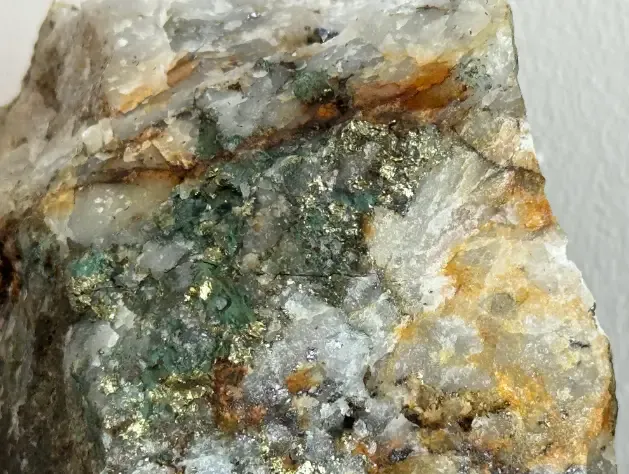
7.4.1 Gold-Bearing Ores
The recovery of gold from gold-bearing ores depends largely on the nature of the deposit,the mineralogy of the ore and the distribution of gold in the ore.The methods used for the recovery of gold consist of the following unit operations:
(1)The gravity preconcentration method,which is used mainly for recovery of gold from placer deposits that contain coarse native gold.Gravity is often used in combination with flotation and/or cyanidation.
(2)Hydrometallurgical methods are normally employed for recovery of gold from oxidized deposits(heap leach),low-grade sulphide ores(cyanidation,CIP,CIL)and refractory gold ores(autoclave,biological decomposition followed by cyanidation).
(3)A combination of pyrometallurgical(roasting)and hydrometallurgical route is used for highly refractory gold ores(carbonaceous sulphides,arsenical gold ores)and the ores that contain impurities that result in high consumption of cyanide,which have to be removed before cyanidation.
(4)The flotation method is a technique widely used for the recovery of gold from gold- containing copper ores,base metal ores,copper nickel ores,platinum group ores and many other ores where other processes are not applicable.Flotation is also used for the removal of interfering impurities before hydrometallurgical treatment(i.e.carbon prefloat),for upgrading of low- sulphide and refractory ores for further treatment.Flotation is considered to be the most cost- effective method for concentrating gold.
Flotation technique is used not only for upgrading of low-grade gold ore for further treatment, but also for beneficiation and separation of difficult-to-treat(refractory)gold ores.Flotation is also the best method for recovery of gold from base metal ores and gold-containing PGM ores. Excluding gravity preconcentration,flotation remains the most cost-effective beneficiation method.
Gold itself is a rare metal and the average grades for low-grade deposits vary between 3g/t and 6g/t.Gold occurs predominantly in native form in silicate veins,alluvial and placer deposits or encapsulated in sulphides.Other common occurrences of gold are alloys with copper,tellurium, antimony,selenium,platinum group metals and silver.In massive sulphide ores,gold may occur in several of the above forms,which affects flotation recovery.
During flotation of gold-bearing massive sulphide ores,the emphasis is generally place on the production of base metal concentrates and gold recovery becomes a secondary consideration.In some cases,where significant quantities of gold are contained in base metal ores,the gold is floated from the base metal tailings.The flotation of gold-bearing ores is classified according to ore type(i.e.gold ore,gold copper ore,gold antimony ores,etc.),because the flotation methods used for the recovery of gold from
different ores is vastly different.
The geology of the deposit and the mineralogy of the ore play a decisive role in the selection of the best treatment method for a particular gold ore.Geology of the gold deposits varies considerably not only from deposit to deposit,but also within the deposit.Table 7.1 shows major genetic types of gold ores and their mineral composition.
More than 50%of the total world gold production comes from clastic sedimentary deposits.In many geological ore types,several sub-types can be found including primary ores,secondary ores and oxide ores.Some of the secondary ores belong to a group of highly refractory ores.The number of old minerals and their associations are relatively small and can be divided into the following three groups:(1)native gold and its alloys;(2)tellurides;(3)gold associated with platinum group metals.Table 7.2 lists the major gold minerals and their associations.
Table 7.1 Common genetic types of gold deposits
| Ore type | Description |
| Magmatic | Gold occurs as an alloy with copper,nickel and platinum group metals. Typically contains low amount of gold |
| Ores in clastic sedimentary rock | Placer deposits,in general conglomerates,which contain quartz,sericite,chlorite, tourmaline and sometimes rutile and graphite.Gold can be coarse.Some deposits contain up to 3%pyrite.Size of the gold contained in pyrite ranges from 0.01μm to 0.07μm |
| Hydrothermal | This type contains a variety of ores,including(1)gold-pyrite ores,(2)gold copper ores,(3)gold-polymetallic ores and(4)gold oxide ore,usually upper zone of sulphide zones.The pyrite content of the ore varies from 3%to 90%.Other common wasteminerals are quartz,aluminosilicates,dolomite etc |
| Metasomatic or skarn ores | Sometimes are very complex and refractory gold ores.Normally the ores are composed of quartz,sericite,chlorites,calcite and magnetite.Sometimes the ore contains wolframite and scheelite |
Table 7.2 Major gold minerals
| Group | Mineral | Chemical formula | Impurity content |
| Native gold andits alloys | Native goldElectrumCuproaurideAmalgamBismuthauride | AuAu/AgAu/CuHg/AuAu/Bi | 0-15%Ag15%-50%Ag 5%-10%Cu 10%-34%Au 2%-4%Bi |
| Tellurides | Calaverite Sylvanite Petzite | AuTe₃AgAuTe₄ Ag₃AuTe₂ | Unstable |
Continued Table 7.2
| Group | Mineral | Chemical formula | Impurity content |
| Gold associated with platinum | Krennerite | AuTe₂ (Pt,P¹) | Up to 10%Pt |
| Platinum gold | AuPt | 30%-40%Rh | |
| Rhodite | AuRh | 5%-11%Rh | |
| group metals | Rhodian gold | AuRh | 5%Os+5%-7%Ir |
| Aurosmiride | Au,Ir,Os |
7.4.2 Flotation Properties of Gold Minerals
Native gold and its alloys,which are free from surface contaminants,are readily floatable with xanthate collectors.Very often however,gold surfaces are contaminated or covered with varieties of impurities.The impurities present on gold surfaces may be argentite,iron oxides,galena, arsenopyrite or copper oxides.The thickness of the layer may be of the order of 1-5μm.Because of this,the flotation properties of native gold and its alloys vary widely.Gold covered with iron oxides or oxide copper is very difficult to float and requires special treatment to remove the contaminants.
Tellurides,on the other hand,are readily floatable in the presence of small quantities of collector,and it is believed that tellurides are naturally hydrophobic.Tellurides from Minnesota (USA)were floated using dithiophosphate collectors,with over 9%gold recovery.
Flotation behaviour of gold associated in the platinum group metals is apparently the same as that for the platinum group minerals(PGMs)or other minerals associated with the PGMs(i.e. nickel,pyrrhotite,copper and pyrite).Therefore,the reagent scheme developed for PGMs also recovers gold.Normally,for the flotation of PGMs and associated gold,a combination of xanthate and dithiophosphate is used,along with gangue depressants guar gum,dextrin or modified cellulose.In the South African PGM operations,gold recovery into the PGM concentrate ranges from 75%to 80%.
Perhaps the most difficult problem in flotation of native gold and its alloys is the tendency of gold to plate,vein,flake and assume many shapes during grinding.Particles with sharp edges tend to detach from the air bubbles,resulting in gold losses.This shape factor also affects gold recovery using a gravity method.
In flotation of gold-containing base metal ores,a number of modifiers normally used for selective flotation of copper lead,lead zinc and copper lead zinc have a negative effect on the floatability of gold.Such modifiers include ZnSO₄·7H₂O,SO₂,Na₂S₂O₅and cyanide when added in excessive amounts.
The adsorption of collector on gold and its floatability is considerably improved by the presence of oxygen.Fig.7.5 shows the relationship between collector adsorption,oxygen concentration in the pulp and conditioning time.The type of modifier and the pH are also important parameters in flotation of gold.
Fig.7.5 Relationship between adsorption of xanthate on gold and conditioning
time in the presence of various concentrations of xanthate
1—concentration 1;2—concentration 2;3—concentration 3
7.4.3 Flotation of Different Types of Gold Ores
7.4.3.1 Low-Sulphide-Containing Gold Ores
The beneficiation of this ore type usually involves a combination of gravity concentration, cyanidation and flotation.For an ore with coarse gold,gold is often recovered by gravity and flotation,followed by cyanidation of the reground flotation concentrate.In some cases,flotation is also conducted on the cyanidation tailing.The reagent combination used in flotation depends on the nature of gangue present in the ore.The usual collectors are xanthates,dithiophosphates and mercaptans.In the scavenging section of the flotation circuit,two types of collector are used as secondary collectors.In the case of a partially oxidized ore,auxiliary collectors,such as hydrocarbon oils with sulphidizer,often yield improved results.The preferred pH regulator is soda ash,which acts as a dispersant and also as a complexing reagent for some heavy metal cations that have a negative effect on gold flotation.Use of lime often results in the depression of native gold and gold-bearing sulphides.The optimum flotation pH ranges between 8.5 and 10.0.The type of frother also plays an important role in the flotation of native gold and gold-bearing sulphides. Glycol esters and cyclic alcohols(pine oil)can improve gold recovery significantly.Amongst the modifying reagents(depressant),sodium silicate,starch,dextrins and lowmolecular-weight polyacrylamides are often selected as gangue depressants.Fluorosilicic acid and its salts can also have a positive effect on the floatability of gold.The presence of soluble iron in a pulp is highly detrimental for gold flotation.The use of small quantities of iron-complexing agents,such as polyphosphates and organic acids,can eliminate the harmful effect of iron.
7.4.3.2 Gold-Containing Mercury/Antimony Ores
In general,these ores belong to a group of difficult-to-treat ores,where cyanidation usually
produces poor extraction.Mercury is partially soluble in cyanide,which increases consumption and reduces extraction.A successful flotation method has been developed using the flowsheet shown in Fig.7.6,where the best metallurgical results were obtained using a three-stage grinding and flotation approach.
The metallurgical results obtained with different grinding configurations are shown in Table 7.3.
Flotation was carried out at an alkaline pH,controlled by lime.A xanthate collector with cyclic alcohol frother(pine oil,cresylic acid)was shown to be the most effective.The use of small quantities of a dithiophosphate-type collector,together with xanthate was beneficial.
Table 7.3 Gold recovery obtained using different flowsheets
| Product | Recovery in concentrate/% | Tailing assays/%(g ·t⁻¹) | ||||||||
| Au | Ag | Sb | As | S | Au | Ag | Sb | As | S | |
| Single-stage grind-flotation | 88.1 | 89.2 | 72.9 | 68.4 | 70.1 | 1.7 | 5.0 | 0.04 | 0.035 | 0.38 |
| Two-slage grind-flotation | 92.2 | 91.8 | 93.4 | 78.7 | 81.2 | 1.0 | 4.1 | 0.015 | 0.022 | 0.27 |
| Three-stage grind-flotation | 95.3 | 95.2 | 95.7 | 81.2 | 85.7 | 0.7 | 2.2 | 0.005 | 0.015 | 0.19 |
7.4.3.3 Carbonaceous Clay-Containing Gold Ores
These ores belong to a group of refractory gold ores,where flotation techniques can be used to(1) remove interfering impurities before the hydrometallurgical treatment process of the ore for gold recovery;(2)to preconcentrate the ore for further pyrometallurgical or hydrometallurgical treatment.There are several flotation methods used for beneficiation of this ore type.Some of the most important methods are described below.
(1)Preflotation of carbonaceous gangue and carbon.In this technique,only carbonaceous gangue and carbon are recovered by flotation,in preparation for further hydrometallurgical treatment of the float tails for gold recovery.Carbonaceous gangue and carbon are naturally floatable using only a frother,or a combination of a frother and a light hydrocarbon oil(fuel oil, kerosene,etc.).When the ore contains clay,regulators for clay dispersion are used.Some of the more effective regulating reagents include sodium silicates and oxidized starch.
(2)Two–stage flotation method.In this technique,carbonaceous gangue is prefloated using the above-described method,followed by flotation of gold-containing sulphides using activator- collector combinations.In extensive studies conducted on carbonaceous gold-containing ores,it was established that primary amine-treated copper sulphate improved gold recovery considerably. Ammonium salts and sodium sulphide(Na₂S·9H₂O)also have a positive effect on gold-bearing sulphide flotation,at a pH between 7.5 and 9.0.The metallurgical results obtained with and without modified copper sulphate are shown in Table 7.4.
Table 7.4 Effect of amine-modified CuSO₄on gold-bearing sulphide
flotation from carbonaceous refractory ore
| Reagent used | Product | Weight/% | Assays/%(g ·t⁻¹) | Distribution/% | ||
| Au | S | Au | S | |||
| CuSO₄+xanthate | Gold sulphide concentrate | 30.11 | 9.63 | 4.50 | 69.1 | 79.7 |
| Gold sulphide tail | 69.89 | 1.86 | 0.49 | 30.9 | 20.3 | |
| Head | 100.00 | 4.20 | 1.70 | 100.0 | 100.0 | |
| Amine modified CuSO₄+xanthate | Gold sulphide concentrate | 26.30 | 13.2 | 5.80 | 84.7 | 90.8 |
| Gold sulphide tail | 73.70 | 0.85 | 0.21 | 15.3 | 9.2 | |
| Head | 100.00 | 4.10 | 1.68 | 100.0 | 100.0 | |
(3)Nitrogen atmosphere flotation method.This technique uses a nitrogen atmosphere in grinding and flotation to retard oxidation of reactive sulphides,and has been successfully applied on carbonaceous ores from Nevada(USA).The effectiveness of the method depends on:(1)the amount of carbonaceous gangue present in the ore;(2)the amount and type of clay.Ores that are high in carbon or contain high clay content(or both)are not amenable for nitrogen atmosphere flotation.
7.4.3.4 Gold-Containing Copper Ores
The loatability of gold from gold-containing copper gold ores depends on the nature and occurrence of gold in these ores,and its association with iron sulphides.Gold in the porphyry copper ore may appear as native gold,electrum,cuproaurid and sulphosalts associated with silver. During the flotation of porphyry copper-gold ores,emphasis is usually placed on the production of a marketable copper-gold concentrate and optimization of gold recovery is usually constrained by the marketability of its concentrate.The minerals that influence gold recovery in these ores are iron sulphides(i.e.pyrite,marcasite,etc.),in which gold is usually associated as minute inclusions.
Thus,the iron sulphide content of the ore determines gold recovery in the final concentrate.
Fig.7.7 shows the relationship between pyrite content of the ore and gold recovery in the copper
concentrate for two different ore types.Most of the gold losses occur in the pyrite.
The reagent schemes used in commercial operations treating porphyry copper-gold ores vary considerably.Some operations,where pyrite rejection is a problem,use a dithiophosphate collector at an alkaline pH between 9.0 and 11.8(e.g.OK Tedi/PNG Grasberg/Indonesia). When the pyrite content in the ore is low,xanthate and dithiophosphates are used in a lime or soda ash environment.In more recent years,in the development of commercial processes for the recovery of gold from porphyry copper-gold ores,bulk flotation of all the sulphides has been emphasized,followed by regrinding of the bulk concentrate and sequential flotation of copper-gold from pyrite.Such a flowsheet(Fig.7.8)can also incorporate high-intensity conditioning in the cleaner-scavenger stage.Comparison of metallurgical results using the standard sequential flotation flowsheet and the bulk flotation flowsheet are shown in Table 7.5.A considerable improvement in gold recovery was achieved using the bulk flotation flowsheet.
Table 7.5 Comparison of metallurgical results using conventional and bulk flotation flowsheets on ore from Peru
| Flowsheet used | Product | Weight/% | Assays/%(g ·t⁻¹) | Distribution/% | ||
| Au | S | Au | S | |||
| Convential(sequential Cu/Au) | Cu/Au concentrateCu/Au tailHead | 2.28 97.72100.00 | 27.60.0310.66 | 32.97 0.230.98 | 95.44.6100.0 | 76.723.3100.0 |
| Bulk | Cu/Au concentrateCu/Au tailHead | 2.32 97.68100.00 | 27.10.0320.66 | 36.94 0.140.96 | 95.24.8100.0 | 85.814.2100.0 |
During beneficiation of clay-containing copper-gold ores,the use of small quantities of Na₂S (at natural pH)improves both copper and gold metallurgy considerably.
In the presence of soluble cations(e.g.Fe,Cu),additions of small quantities of organic acid (e.g.oxalic,tartaric)improve gold recovery in the copper concentrate.
Some porphyry copper ores contain naturally floatable gangue minerals,such as chlorites and
aluminosilicates,as well as preactivated quartz.Sodium silicate,carboxy methylcellulose and dextrins are common depressants used to control gangue flotation.Gold recovery from massive sulphide copper-gold ores is usually much lower than that of porphyry copper-gold ores,because very often a large portion of the gold is associated with pyrite. Normally,gold recovery from these ores does not exceed 60%.During the treatment of copper- gold ores containing pyrrhotite and marcasite,the use of Na₂H₂PO₄at alkaline pH values depresses pyrrhotite and marcasite,and also improves copper and gold metallurgy.
7.4.3.5 Oxide Copper-Gold Ores
Oxide copper-gold ores are usually accompanied by iron hydroxide slimes and various clay minerals.Treatment of these ores is difficult,and even more complicated in the presence of clay minerals.
Recently,a new class of collectors,based on ester-modified xanthates,have been successfully used to treat gold-containing oxide copper ores,using a sulphidization method.Table 7.6 compares the metallurgical results obtained on the Igarape Bahia ore using xanthate and a new collector.
The modifier used in the flotation of these ores included a mixture of sodium silicate and Calgon.Good selectivity was also achieved using boiled starch.
Table 7.6 Effect of collector PM230 on copper/gold recovery from Igarape Bahia oxide copper/gold ore
| Reagent used | Product | Weight/% | Assays/%(g ·t-¹) | Distribution/% | ||
| Au | S | Au | S | |||
| Na₂S=2500g/t PAX①=200g/t | Copper Cl concentrate | 9.36 | 33.3 | 14.15 | 67.0 | 50.0 |
| Copper tail | 90.64 | 1.61 | 1.46 | 33.0 | 50.0 | |
| Feed | 100.00 | 4.65 | 2.65 | 100.0 | 100.0 | |
| Na₂S=2500g/tPAX①PM230(1:1)=200g/t | Copper Cl concentrate | 10.20 | 39.5 | 21.79 | 88.0 | 85.5 |
| Copper tail | 89.80 | 0.61 | 0.42 | 12.0 | 14.5 | |
| Feed | 100.00 | 0.61 | 0.42 | 12.0 | 14.5 | |
①PAX=potassium amyl xanthate.
7.4.3.6 Gold-Antimony Ores
Gold-antimony ores usually contain stibnite(1.5%-4.0%Sb),pyrite,arsenopyrite,gold(1.5- 3.0g/t)and silver(40-150g/t).Several plants in the United States and Russia have been in operation for some time.There are two commercial processes available for treatment of these ores:
(1)Selective flotation of gold-containing sulphides followed by flotation of stibnite with pH change.Stibnite floats well in neutral and weak acid pH,whereas in an alkaline(i.e.pH>8)it is reduced.Utilizing this phenomenon,gold-bearing sulphides are floated with xanthate and alcohol frother in alkaline medium(i.e.pH>9.3)followed by stibnite flotation at about pH 6.0,after activation with lead nitrate.Typical metallurgical results using this method are shown in Table 7.7.
Table 7.7 Product metallurgical results obtained using a sequential flotation method
| Product | Weight/% | Assays/%(g ·t⁻¹) | Distribution/% | ||||
| Au | Ag | Sb | Au | Ag | Sb | ||
| Gold concentrate | 2.34 | 42.3 | 269.3 | 20.0 | 53 | 13 | 15 |
| Stibnite concentrate | 4.04 | 6.2 | 559.8 | 51.0 | 13 | 51 | 64 |
| Tailing | 93.62 | 0.65 | 18.7 | 0.7 | 34 | 36 | 21 |
| Feed | 100.00 | 1.86 | 46.4 | 3.2 | 100.0 | 100.0 | 10.0 |
(2)Bulk flotation followed by sequential flotation of gold-bearing sulphides,and depression of stibnite.This method was practiced at the Bradly concentrator(USA)and consisted of the following steps:1)bulk flotation of stibnite and gold-bearing sulphides at pH=6.5 using lead nitrate(i.e.Sb activator)and xanthate,2)the bulk concentrate is reground in the presence of NaOH(pH=10.5)and CuSO₄,and the gold-bearing sulphides are refloated with additions of small quantities of xanthate,3)cleaning of the gold concentrate in the presence of NaOH and NaHS.The plant metallurgical results employing this method are shown in Table 7.8.
Table 7.8 Plant metallurgical results obtained using a bulk flotation method
| Product | Weight/% | Assays/%(g ·t⁻¹) | Distribution/% | ||||
| Au | Ag | Sb | Au | Ag | Sb | ||
| Gold concentrate | 1.80 | 91.1 | 248.8 | 1.5 | 61.0 | 31.3 | 2.0 |
| Antimony concentrate | 1.80 | 13.0 | 684.2 | 51.3 | 9.0 | 58.6 | 75.0 |
| Middlings | 0.50 | 46.6 | 248.8 | 20.0 | 8.6 | 6.0 | 8.0 |
| Bulk concentrate | 4.10 | 51.7 | 440.0 | 29.0 | 78.6 | 85.9 | 85.0 |
| Tailing | 95.90 | 0.6 | 3.1 | 0.2 | 21.4 | 14.1 | 15.0 |
| Feed | 100.00 | 2.7 | 21.0 | 1.3 | 100.0 | 100.0 | 100.0 |
Recent studies conducted on ore from Kazakhstan have shown that sequential flotation using thionocarbamate collector gave better metallurgical results than those obtained with xanthate.
7.4.3.7 Arsenical Gold Ores
There are two major groups of arsenical gold ores of economical value.These are the massive base metal sulphides with arsenical gold(i.e.the lead-zinc Olympias deposit,Greece)and arsenical gold ores without the presence of base metals.Massive,base metal arsenical gold ores are rare, and there are only a few deposits in the world.A typical arsenical gold ore contains arsenopyrite as the major arsenic mineral.However,some arsenical gold ores,such as those from Nevada in the USA(Getchel deposit),contain realgar and orpiment as the major arsenic-bearing minerals. Pyrite,if present in an arsenical gold ore,may contain some gold as minute inclusions.
Flotation of arsenical gold ores associated with base metals is accomplished using a sequential flotation technique,with flotation of base metals followed by flotation of gold- containing pyrite/arsenopyrite.The pyrite/arsenopyrite is floated at a weakly acid pH with a xanthate collector.
Arsenical gold ores that do not contain significant base metals are treated using a bulk flotation method,where all the sulphides are first recovered into a bulk concentrate.In case the gold is contained either in pyrite or arsenopyrite,separation of pyrite and arsenopyrite is practiced.There
are two commercial methods available.The first method utilizes arsenopyrite depression and pyrite flotation,and consists of the following steps:
(1)Heat the bulk concentrate to 75℃ at a pH of 4.5(controlled by H₂SO₄)in the presence of small quantities of disodium phosphate.The temperature is maintained for about 10min.
(2)Flotation of pyrite using either ethyl xanthate or potassium butyl xanthate as collector. Glycol frother is also usually employed in this separation.
This method is highly sensitive to temperature.Fig.7.9 shows the effect of temperature on pyrite/arsenopyrite separation.In this particular case,most of the gold was associated with pyrite.
Successful pyrite/arsenopyrite separation can also be achieved with the use of potassium peroxy disulphide as the arsenopyrite depressant.The second method involves depression of pyrite and flotation of arsenopyrite.In this method,the bulk concentrate is treated with high dosages of lime(i.e.pH>12), followed by a conditioning step with CuSO₄to activate arsenopyrite.The arsenopyrite is then floated using a thionocarbamate collector.
Fig.7.9 Effect of temperature on separation of pyrite and arsenopyrite from a bulk pyrite/arsenopyrite concentrate
Separation of arsenopyrite and pyrite is important from the point of view of reducing downstream processing costs.Normally,roasting or pressure oxidation followed by cyanidation is used to recover gold.
7.4.3.8 Base Metal Sulphide Ores
Very often lead-zinc,copper-zinc,copper-lead-zinc and copper-nickel ores contain significant quantities of gold(i.e.between 1 and 9g/t).The gold in these ore types is usually found as elemental gold.A large portion of the gold in these ores is finely disseminated in pyrite,which is considered non-recoverable.Because of the importance of producing commercial-grade copper, lead and zinc concentrates,little or no consideration is given to improvement in gold recovery, although the possibility exists to optimize gold recovery in many cases.Normally,gold recovery from base metal ores ranged from 30%to 75%.
In the case of a copper-zinc and copper-lead-zinc ore,gold collects in the copper concentrate.
During the treatment of lead-zinc ores,the gold tends to report to the lead concentrate. Information regarding gold recovery from base metal ores is sparse.The most recent studies conducted on various base metal ores revealed some important features of flotation behaviour of gold from these ores.It has been demonstrated that gold recovery to the base metal concentrate can be substantially improved with the proper selection of reagent schemes.
7.4.3.9 Gold-containing Lead-zinc Ores
Some of these ores contain significant quantities of gold, ranging from 0.9g/t to 6.0g/t.The gold recovery from these ores ranged from 35%to 75%.Laboratory studies have shown that the use of high dosages of zinc sulphate,which is a common zinc depressant used in lead flotation,reduces gold floatability significantly. The effect of ZnSO₄·7H₂O addition on gold recovery in the lead concentrate is illustrated in Fig.7.10.
In order to improve gold recovery in the lead concentrate,an alternative depressant to ZnSO₄·7H₂O can be used. Depressant combinations such as Na₂S + NaCN,or Na₂SO₃+NaCN,may be used.
Fig.7.10 Effect of ZnSO₄additions on gold recovery from lead-zinc ores
Gold recovery from copper-zinc ores is usually higher than that obtained from either a lead-zinc or copper lead-zinc ore.This is attributed to two main factors:when selecting a reagent scheme for treatment of Cu-Zn ores,there are more choices than for the other ore types,which can lead to the selection of a reagent scheme more favourable for gold flotation.In addition,a non-cyanide depressant system can be used for the treatment of these ores,which in turn results in improved gold recovery.This option is not available during treatment of lead-zinc ores.Table 7.9shows the effect of different depressant combinations on gold recovery from a copper-zinc ore.The use of a non-cyanide depressant system resulted in a substantial improvement in gold recovery in the copper concentrate.
Table 7.9 Effect of different depressant combinations on gold recovery to the copper concentrate from lower zone Kutcho Creek ore
| Depressant system | Product | Weight/% | Assays/%(g ·t⁻¹) | Distribution/% | ||||
| Au | Ag | Sb | Au | Ag | Sb | |||
| ZnSO₄,NaCN,CaOpH 8.5 Cu,10.5 Zn | Cu concentrate | 3.10 | 20.4 | 26.2 | 330 | 45.1 | 85.6 | 2.8 |
| Zn concentrate | 5.34 | 1.20 | 0.61 | 55.4 | 4.6 | 3.4 | 82.2 | |
| Tailings | 91.56 | 0.77 | 0.11 | 0.58 | 50.3 | 11.0 | 15.0 | |
| Feed | 100.00 | 1.4 | 0.95 | 3.60 | 100.0 | 100.0 | 100.0 | |
7.4 Gold Ores
Continued Table 7.9
| Depressant system | Product | Weight/% | Assays/%(g ·t⁻¹) | Distribution/% | ||||
| Au | Ag | Sb | Au | Ag | Sb | |||
| Na₂SO₃,NaHS,CaOpH 8.5 Cu,10.5 Zn | Cu concentrate | 3.05 | 32.5 | 28.1 | 2.80 | 68.3 | 87.4 | 2.3 |
| Zn concentrate | 5.65 | 1.20 | 0.55 | 54.8 | 4.7 | 3.2 | 84.6 | |
| Tailings | 91.30 | 0.43 | 0.10 | 0.52 | 27.0 | 9.4 | 13.1 | |
| Feed | 100.00 | 1.45 | 0.98 | 3.66 | 100.0 | 100.0 | 100.0 | |
7.4.3.11 Gold-containing Copper-lead-zinc Ores
Because of the complex nature of these ores,and the requirement for a relatively complex reagent scheme for treatment of this ore,the gold recovery is generally lower than that achieved from a lead-zinc or copper-zinc ore.One of the major problems associated with the flotation of gold from these ores is related to gold mineralogy.A large portion of the gold is usually contained in pyrite, at sub-micron size.If coarse elemental gold and electrum are present,the gold surfaces are often coated with iron or lead,which can result in a substantial reduction in floatability.
The type of collector and flowsheet configuration play an important role in gold recovery from these ores.With a flowsheet that uses bulk Cu-Pb flotation followed by Cu-Pb separation,the gold recovery is higher than that achieved with a sequential Cu-Pb flotation flowsheet.In laboratory tests,and Aerophine collector type,in combination with xanthate,had a positive effect on gold recovery as compared to either dithiophosphate or thionocarbamate collectors.Table 7.10 compares the metallurgical results obtained with an Aerophine collector to those obtained with a dithiophosphate collector.
Table 7.10 Effect of collector type on Cu-Pb-Zn-Au metallurgical results from a high-lead ore,Crandon(USA)
| Collector | Product | Weight/% | Assays/%(g ·t⁻¹) | Distribution/% | ||||||
| Au | Cu | Pb | Zn | Au | Cu | Pb | Zn | |||
| 30g/t xanthate20g/t dithiophosphate 3477 | Cu concentrate | 2.47 | 22.4 | 25.5 | 1.20 | 4.50 | 41.6 | 78.6 | 2.3 | 1.3 |
| Pb concentrate | 1.80 | 2.50 | 0.80 | 51.5 | 8.30 | 3.4 | 1.8 | 71.3 | 1.7 | |
| Zn concentrate | 13.94 | 1.10 | 0.60 | 0.80 | 58.2 | 11.5 | 10.4 | 8.6 | 92.2 | |
| Tailing | 81.79 | 0.71 | 0.089 | 0.28 | 0.52 | 43.5 | 9.1 | 17.8 | 4.8 | |
| Feed | 100.00 | 1.33 | 0.80 | 1.30 | 8.80 | 100.0 | 100.0 | 100.0 | 100.0 | |
| 30g/t xanthate20g/t aerophine 3418A | Cu concentrate | 2.52 | 31.3 | 26.1 | 1.10 | 5.00 | 60.6 | 80.1 | 2.1 | 1.4 |
| Pb concentrate | 1.92 | 2.80 | 0.90 | 51.1 | 9.20 | 4.1 | 2.1 | 72.5 | 2.0 | |
| Zn concentrate | 13.91 | 0.90 | 0.50 | 0.72 | 58.5 | 9.6 | 8.5 | 7.4 | 92.5 | |
| Tailing | 81.65 | 0.41 | 0.093 | 0.30 | 0.44 | 25.7 | 9.3 | 18.0 | 4.1 | |
| Feed | 100.00 | 1.30 | 0.82 | 1.35 | 8.80 | 100.0 | 100.0 | 100.0 | 100.0 | |
Chapter 7 Beneficiation Practice of Non-ferrous Metallic Ores
Because of the complex nature of gold-containing Cu-Pb-Zn ores,the reagent schemes used are also complex.Reagent modifiers such as ZnSO₄,NaCN and lime have to be used,all of which have a negative effect on gold flotation.
7.4.4 Conclusions
The flotation of gold-bearing ores,whether for production of bulk concentrates for further gold recovery processes(i.e.pyrometallurgy,hydrometallurgy)or for recovery of gold to base metal concentrates,is a very important method for concentrating the gold and reducing downstream costs.
The flotation of elemental gold,electrum and tellurides is usually very efficient,except when these minerals are floated from base metal,massive sulphides.
Flotation of gold-bearing sulphides from ores containing base metal sulphides present many challenges and should be viewed as flotation of the particular mineral that contains gold(i.e. pyrite,arsenopyrite,copper,etc.),because gold is usually associated with these minerals at micron size.
Selection of a flotation technique for gold preconcentration depends very much on the ore mineralogy,gangue composition and gold particle size.There is no universal method for flotation of the gold-bearing minerals,and the process is tailored to the ore characteristics.A specific reagent scheme and flowsheet are required for each ore.There are opportunities in most operating plants for improving gold metallurgy.Most of these improvements come from selection of more effective reagent schemes,including collectors and modifiers.
Perhaps the most difficult ores to treat are the clay -containing carbonaceous sulphides.
Significant progress has been made in treatment options for these ores.New sulphide activators (i.e.amine-treated CuSO₄,ammonium salts)and nitrogen gas flotation are amongst the new methods available.