REO Minerals
7.6.1 Ore and Minerals Containing Rare Earth Oxide Elements(REOE) There are about 250…
Lead and Zinc Ore
7.3.1 Natural Minerals of Lead and Zinc and Their Floatability
Lead and zinc are closely related in nature,especially in primary deposits.They have the same
7.3 Lead and Zinc Ore
source of ore-forming materials,very similar geochemical behavior,similar outer electronic structure,strong sulfur affinity and the same soluble complexes.
There are more than 250 kinds of lead-zinc minerals found in the earth’s crust,about 1/3 of which are sulfides and sulfates.Galena and sphalerite are the main industrial mineral for smelting lead and zinc,followed by smithsonite and cerussite.
According to the oxidation rate of lead or zinc,its industrial types include sulfide ore with oxidation rate less than 10%,oxidized ore with oxidation rate more than 30%,mixed ore with oxidation rate between 10%to 30%.
The ore structure includes disseminated,dense massive,brecciated,banded,and veinlet,etc.
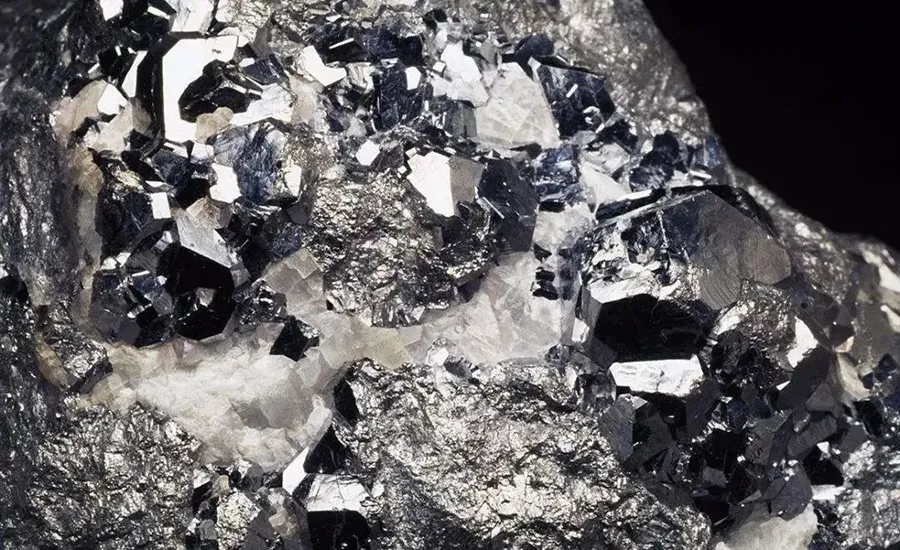
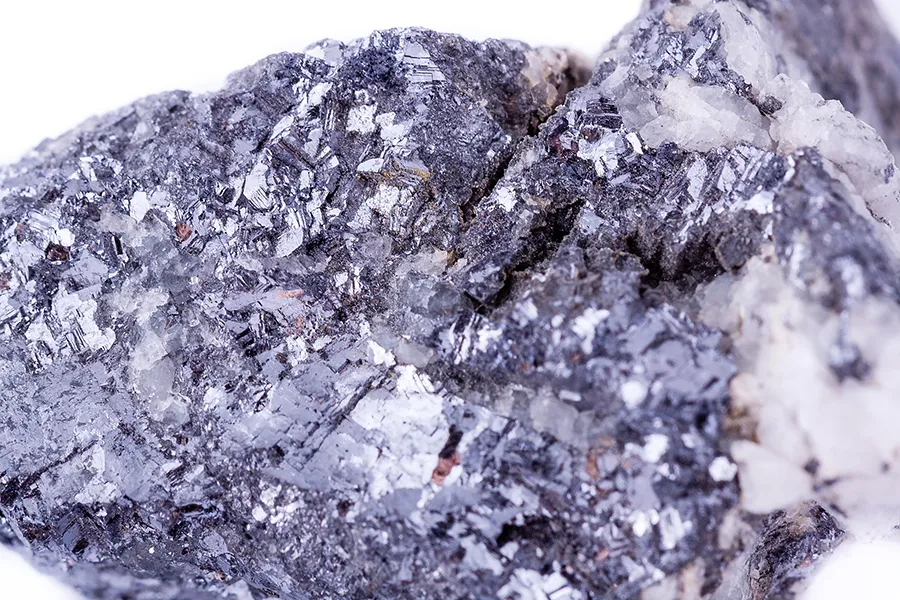
Galena contains 86.6%Pb,often containing Ag,Bi,Sb,Se,etc.Galena is lead gray in color with gray black stripe and metallic luster.Its hardness is 2-3 and density 7.4-7.6g/cm³.It mainly occurs in the polymetallic sulfide deposits of middle temperature hydrothermal solution. Galena is almost always associated with sphalerite and is easily weathered to anglesite and cerussite on the surface.
Sphalerite contains 67.1%Zn,and usually various kinds of isomorphic elements such as Fe.
With the increasing of iron content,the color changes from light to dark,from light yellow to black,with white to brown stripes,and the luster changes from resin luster to semi metal luster; from transparent to translucent.The hardness is 3.5-4 and the density is 3.9-4.1g/cm³,which decreases with the increase of Fe content.Sphalerite is easy to be weathered into smithsonite on the surface.
Cerussite is transparent or translucent white,and its inclusions containing lead are gray,light green or blue,with metallic luster,sometimes with grease or pearl luster.Cerussite is formed by the oxidation of galena to anglesite and then reacted with carbonate solution.
Smithsonite has a hardness of 4-5 and density 4-4.5g/cm³ .
7.3.1.1 Floatability of Galena PbS
Galena is easy to be collected with thiocompound collectors in a wide pH range.Xanthate, dithiophosphate,dithiocarbamate and white agent are all effective.Neutral oil such as diesel oil also has a good collection on galena,especially fine galena,and is thus often used as auxiliary collector.Dithiophosphate is weaker in collection than that of xanthate,but shows better selectivity,and is especially suitable for galena containing silver.Dithiocarbamate and white agent also show good selectivity in galena flotation.
Impurities have a great influence on the floatability of galena,for example,silver or copper improves the floatability of galena,while zinc,manganese or antimony decreases its floatability. Impurities also affect the effect of depressants.For example,galena containing very fine inclusions of zinc or manganese is more strongly depressed by cyanide than those containing bismuth or copper.The most suitable pH for galena flotation of is 7-10.
Chapter 7 Beneficiation Practice of Non-ferrous Metallic Ores
Many metal cations can significantly depress galena,and the depressing increases with increasing valence,for example,Cr²+and Al³+have a strong depressing effect on galena.Sodium or potassium dichromate is the most important depressant of galena and the depressing occurs easily in the alkaline medium but reduces in acid medium.The galena depressed by dichromate can be partially activated by FeSO₄,hydrochloric acid or by NaCl in acid medium.Galena is more readily depressed by sodium sulfide than other sulfide minerals,but this depression is temporary and will disappear after a period of time.Water glass is also the depressant of galena,but weaker than dichromate.Sodium phosphate,phosphoric acid and sulfite can also depress galena.
7.3.1.2 Floatability of Sphalerite ZnS
The floatability of sphalerite depends largely on the impurities in the lattice,especially the content of iron.Generally,sphalerite with high iron content has poor floatability,while that with cadmium is easy to float.Many sphalerites in nature have improved their floatability due to the natural activation of heavy metal ions,especially copper ions,or due to its oxidation.
Low-grade xanthate has little or even no collection on sphalerite but can collect sphalerite activated by Cu²+.High-grade xanthate can be used to collect sphalerite without activation.
The activation of sphalerite by copper sulfate depends greatly on the pH of pulp,being strongest at pH=6 and pH=11.When some sphalerites are seriously activated,contain inclusions of copper minerals in micro or colloidal form,have copper ion infiltration in the lattice,or there is more Cu²+in the pulp,it often brings about great difficulty for the separation of copper and zinc by flotation.
The main depressants of sphalerite are cyanide,zinc sulfate,sodium sulfide,sulfite and its salts,sodium thiosulfate,etc.
7.3.2 Beneficiation Process for Lead and Zinc Sulfides
7.3.2.1 Flotation Process
Lead zinc sulfide ores generally have low mineral content,and most of minerals are finely disseminated,often associated with a variety of valuable components which have obvious differences in floatability.All these make flotation the most adoptable method for lead zinc sulfide ore beneficiation.There are various of flotation processes involving selective flotation process,bulk flotation process,iso-floatation process,differential bulk flotation process,branched flotation process in series,and so on.
(1)Selective flotation process is suitable for small plants with few gangue minerals,and can generally obtain high-quality concentrate.
(2)Bulk flotation process is suitable for the poor and can obtain high recovery,sometimes with primary grinding and roughing to discard tailings.However,the useful components are often difficult to separate due to large quantity of reagent on their surface adsopted during bulk flotation, so it is difficult to get high-quality concentrate.
7.3 Lead and Zinc Ore
(3)Iso-flotation process utilizes the natural floatability of minerals,avoiding large quantity of regulators which may cause complex physical and chemical problems.There are no excessive depressants and the valuable minerals can be floated completely,which helps to improve the recovery.There are also no excessive activators,which helps to improve the quality of the concentrates and save reagents consumption.
(4)Differential bulk flotation process,also called as asynchronous flotation process,is developed on the basis of iso-flotation.In this process,lead is not floated completely in one time as in iso-flotation,but is floated in two steps of bulk flotation,where lead and zinc are both floated.In the first step which is like iso-slotation,with no regulators used,only part of the lead is floated.Those galena particles with poorer floatability are floated together with sphalerite which is activated by copper sulfate in the second step flotation.This process is applicable for polymetallic sulfide ore to improve the recovery of associated gold and silve.
(5)Branched flotation process in series is to split the pulp into two or more branches.The froth of the rougher from the first branch is combined with the feed to the second branch,followed by roughing,and then connected in series.Corresponding reagents is added at the same time.
7.3.2.2 Separation of Lead and Sulfur
Pyrite is usually associated with lead-zinc ores,and the separation process of lead and sulfur depends on the dissemination characteristics of pyrite.
If there is a small amount of pyrite which is in coarse grains,sulfur flotation process with zinc depressed can be adopted.The reagent regime can be the combination of sodium carbonate,zinc sulfate and sodium sulfide,or zinc sulfate and sodium sulfide,or sodium sulfite,sodium sulfate and zinc sulfate.
If there is some pyrite with good floatability,pyrite will float with galena in the traditional process.If pH is increased to depress pyrite,galena will also be depressed.In this case,a large quantity of lime is usually used to depress pyrite and high-grade xanthate is used to collect galena.
7.3.2.3 Separation of Zinc and Sulfur
In the separation of zinc and sulfur,cupric sulfate and lime are used to activate sphalerite and depress pyrite,respectively.And the pulp is heated to 50℃ to improve the separation efficiency of zinc and sulfur.
7.3.3 Beneficiation Practice in Fankou Lead Zinc Ores
7.3.3.1 Introduction to Fankou Lead Zinc Mine
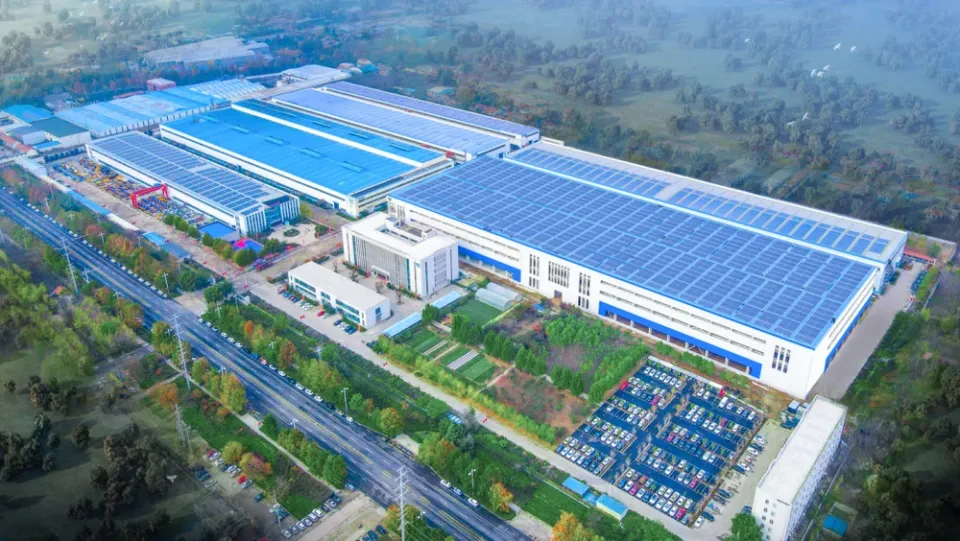
Fankou Lead Zinc Concentrator handles 1.5-1.65million tons of run-of-mine ore annually.Its main products are high lead concentrate,high zinc concentrate,bulk concentrate of lead and zinc, and sulfur concentrate.The annual output of lead and zinc metals is 165000-180000 tons,and
Chapter 7 Beneficiation Practice of Non-ferrous Metallic Ores
standard sulfur concentrate 550000-700000 tons.
The ore in Fankou is mainly a complex and dense lead-zinc sulfide ore with pyrite content of up to 45%.Galena,sphalerite and pyrite are distributed unevenly in size and have complex structure,with -0.074mm accounting for 35%,17%and 49%,and-0.02mm accounting for 16%,4%and 8%,respectively.It is difficult to beneficiate.
The technology innovation and production practice of Fankou complex lead-zinc ore dressing have been carried out for decades,which made great contribution to the development of sulfide ore dressing technology in China.The non-cyanide technology,high alkali fine grinding technology, asynchronous bulk flotation technology,rapid flotation technology with mixed reagents,and potential controlled flotation technology have been successful,which have solved the difficult problem of complex sulfide ore dressing and contributed to improvements of the sulfide ore dressing technology in China to be the world’s advanced level.
7.3.3.2 Development of Flotation Process
Bulk flotation process was used when the plant was built in 1968.The run-of-mine ore was ground to -0.074mm accounting for 70%.The lead-zinc bulk concentrate was obtained by bulk flotation using lime,copper sulfate and ethyl xanthate.After regrinding,the bulk concentrate was separated using lime,cyanide and zinc sulfate,to get lead and zinc concentrate,respectively. Sulfur concentrate was obtained from flotation of the bulk tailings.This process used cyanide, which brought about environmental pollution and gave low separation efficiency.
In the mid-1970s,environmental protection has been paid increasing attention.The process gave up cyanide and produces high-grade bulk concentrate for Imperial Smelting Process(ISP), which can treat bulk concentrate instead of separate concentrate as in traditional smelters.
The liberation degree of galena is only 60%when -0.074mm accounts for 70%,so fine grinding was necessary.But fine grinding made large quantity of fine pyrite,galena and their lock particles present quite similar floatability,resulting in difficult separation.After a long time of research,selective flotation process at high alkali condition with strong collector was developed. The run-of-mine ore was ground to-0.074mm accounting for 85%and the lead concentrate was reground to-0.038mm accounting for 85%-90%.Large quantity of lime and butyl xanthate were added into the ball mill,where high alkali environment depressed the newly liberated pyrite,while butyl xanthate protecting the fresh galena surface.Lead concentrate is obtained in selective flotation involving one roughing,one scavenging and four cleanings using zinc sulfate and terpineol.This process made progress in increasing both the lead recovery and the quality and recovery of zinc concentrate,but the lime depression is not complete,making the separation of lead and iron difficult,and resulting in high circulating load.The grade of lead concentrate is about 50%-52%.Differential bulk flotation,also called asynchronous flotation,was tested to be successful in 1987 and produced coarse bulk concentrate,which was reground and cleaned.However,there were several problems.It showed poor adaptability to the market because bulk concentrate is the only product.Overgrinding happened during regrinding of the coarse bulk concentrate although recovery was increased.Fluctuation and lost happened because the floated material was of large quantity in bulk flotation.In addition,aniline aerofloat is readily to decompose which presented great pressure for environmental protection.
On the basis of selective flotation at high alkali condition,mixed collectors and organic depressant were then used,and zinc sulfate was stopped,returning the cleaning tailings by skipping,increased the lead grade from 53%to 58%.
In 1998 and 1999,potential controlled flotation completed its industrial test successfully, combining the theory of modern sulfide potential control with production practice,further made the relationship between mineral flotation behavior and pulp potential clear,and optimized the reagent regime and flowsheet structure as well.
7.3.3.3 FKNSP Process
FKNSP is the latest developed harmonious ore dressing technology for complex lead zinc iron sulfide ore,adopting the concept and principle of “harmony”,making full use of the inherent characteristics and floatability of minerals in the ore and realized energy saving.It produces four products,lead concentrate,zinc concentrate,bulk concentrate and sulfur concentrate,described as follows in Fig.7.4.
Considering the fact that most of the main metal minerals have been liberated at coarser
grinding,coarse grinding of run-of-mine ore and regrinding of middlings are used,aiming toregrind the small amount of lock particles that are difficult or slow to float,saving electricity
Chapter 7 Beneficiation Practice of Non-ferrous Metallic Ores
consumption.Most of the coarse and easy-to-float particles of lead or zinc are floated quickly in a short time to produce lead or zinc concentrate,reducing overgrinding of liberated minerals and unnecessary recycling load.The middlings which are difficult to treat are combined and reground to produce bulk concentrate of high quality,increasing metal recovery and shortening the flowsheet.This process makes full use of the combined effect of flotation reagents and adopts mixed reagents to strengthen the separation efficiency of lead and zinc minerals.The quick flotation of most of the lead and zinc concentrates helps to eliminate the cumulative effect of flotation reagents and the negative impact caused by excessive reagents.This harmonious process and product structure,and targeted flotation reagent regime,reduce the circulation load in the flowsheet and total flotation time.
The FKNSP process consists of quick flotation of lead,slow flotation of lead,quick flotation of zinc,slow flotation of zinc,and bulk flotation.The reagent regime and flotation time are described below.
The ore is ground in a two-stage closed-circuit.Butyl xanthate,ethyl dithiocarbamate and lime are added into the primary ball mill at dosage of 65g/t,65g/t,and 5000g/t,respectively.
(1)Quick flotation of lead.It includes one rougher and three cleaners,with flotation time of 6min,11min,9min,and 23min,respectively.Frother is the only reagent added in roughing operation,and small amount of butyl xanthate,ethyl dithiocarbamate and lime are added in each cleaning operation.The middlings return in sequence,while the rougher tailings go for slow flotation of lead.Sodium humate(PS)is also used in the second cleaning operation to depress pyrite.Sodium humate is nontoxic,tasteless,environmentally friendly,and of low consumption, reducing the amount of lime and gives good adaptability to water quality.
(2)Slow flotation of lead.It includes one rougher and one scavenger.Lime,butyl xanthate, and ethylthionitrogen are added in rougher at 500g/t,125g/t and 12.5g/t,respectively.Butyl xanthate is added in scavenger at 15g/t.
(3)Quick flotation of zinc.It consists of one rougher and three cleaners.Butyl xanthate and oil
Ⅱ are added in the agitating bulk at 120g/t and 15g/t,respectively.Copper sulfate,lime,butyl xanthate are added prior to each cleaning operation at a decreasing dosage.The flotation time is 7min,7min,13min and 26min,respectively.The tailings of the roughing go to slow flotation of zinc.
(4)Slow flotation of zinc.It consists of one rougher and three scavengers.Butyl xanthate and oil Ⅱ are added in roughing at 20g/t and 5g/t,respectively.The concentrate of the rougher returns to the regrinding circuit closed by cyclone.Butyl xanthate is added in scavengers.The tailings of the scavenger is dewatered followed by sulfur flotation.The flotation time is 4min, 3min,4min and 4min,respectively.
(5)Bulk flotation.The froth from both slow flotations of lead and zinc are combined and reground,followed by bulk flotation to obtain bulk concentrate of lead and zinc.The bulk flotation consists of five cleaners,with flotation time 6min,5min,5min,5min,and 20min, respectively.